

- MEDDIC, MEDDICC and MEDDPICC share the same six-element core; MEDDICC adds Competition, MEDDPICC adds Paper Process and Competition.
- PTC built MEDDIC in 1996 by reverse-engineering lost deals: listing what was missing when deals failed, then requiring it to be present to win.
- Every qualification model rests on the same premise. SPICED, BANT and the rest are the same idea, packaged around what each author thought mattered most.
- Customise the letters and their meaning to your own buyers and motion; a model adapted to your reality gets used, one adopted unchanged gets forgotten.
- Use MEDDIC for simpler deals, MEDDPICC for complex enterprise deals where procurement and competitors decide the outcome.
- The model you pick matters less than whether it is run. Embed it in process, playbook and weekly coaching, and internalise it before leaning on AI.
MEDDIC, MEDDICC and MEDDPICC are the same qualification framework at three levels of detail. This guide covers what the extra letters add, where the framework came from, and which version to use for the way your team actually sells. Whichever you choose, it is a qualification standard, and it only works when it is run, not just logged.
The short answer
All three share an identical core: six things you need to know to qualify a B2B deal. The longer versions add extra discipline for deals where more can go wrong.
- MEDDIC: the original six. Metrics, Economic Buyer, Decision Criteria, Decision Process, Identify Pain, Champion.
- MEDDICC: the same six, plus a second C for Competition (seven elements).
- MEDDPICC: the same six, plus P for Paper Process and C for Competition (eight elements).
So the real question is not "which is best." It is "how much of this deal can hurt me, and which letters force me to look at it?"
Side by side
| Element | What it qualifies | MEDDIC | MEDDICC | MEDDPICC |
|---|---|---|---|---|
| M Metrics | The quantified business outcome the buyer gets | ✓ | ✓ | ✓ |
| E Economic Buyer | Who holds the budget and signs | ✓ | ✓ | ✓ |
| D Decision Criteria | What the options are judged against | ✓ | ✓ | ✓ |
| D Decision Process | The steps the buyer takes to decide | ✓ | ✓ | ✓ |
| I Identify Pain | The problem and the cost of leaving it | ✓ | ✓ | ✓ |
| C Champion | An insider who sells for you | ✓ | ✓ | ✓ |
| P Paper Process | Legal, security and procurement after yes | – | – | ✓ |
| C Competition | Who else is in the deal, including do nothing | – | ✓ | ✓ |
A note on naming: MEDDICC usually means MEDDIC plus Competition. A few teams use the second C for Closing or Compelling Event instead, so when someone says MEDDICC, it is worth checking which C they mean.
Where they came from
All three trace back to one source, and to one piece of logic worth understanding. MEDDIC was created inside PTC in 1996 by Dick Dunkel and Jack Napoli, under sales leader John McMahon.
They did not start with a theory of selling. They looked back at deals that did not close, asked what had been missing from each one, and found the same gaps recurring. Then they reverse-engineered those gaps into a list: the things that must be present, and proven, for a deal to close. That is the core logic of MEDDIC, and of every version since. It is not a pitch framework. It is a checklist of what a winnable deal contains, built from the post-mortems of the ones that were lost.
The discipline worked. It helped take PTC from roughly $300M to $1B in revenue in four years, and underpinned a long run of consecutive growth quarters. The extra letters were added later as enterprise deals got more complex: Competition, because deals were increasingly lost to a rival or to "no decision" the seller had underestimated; Paper Process, because deals won on the merits still died, or slipped quarters, in legal, security review and procurement. MEDDPICC, popularised through Andy Whyte's work and book, is the version most enterprise SaaS teams now use.
Every qualification model rests on the same premise
This is also why the wider framework debate matters less than it looks. SPICED, BANT, Command of the Message, the MEDD family: nearly every qualification model is built on the same premise PTC started with. Each is a list of what a winnable deal contains. They differ mainly in what the person who built the model thought mattered most, and in how they packaged and named it. One leans on pain and impact, another on budget and authority, another on metrics and the economic buyer, but they are describing the same underlying reality of how B2B deals are won and lost.
The practical takeaway: do not treat the choice of model as a religion. The letters are a starting point, not scripture. You can, and should, customise them to your own buyers and sales process, and customise the interpretation of each letter to your motion. What "Champion" or "Metrics" requires in a founder-led £40k deal is not what it requires in a seven-figure enterprise pursuit. A model you have adapted to your reality gets used. A model you have adopted unchanged from a book gets filled in once and forgotten.
What the extra letters actually buy you
Competition (the second C). Every deal has competition, even when no other vendor is named. The status quo is a competitor, and often the one that wins. Making Competition an explicit qualification element forces the rep to find out who else is being evaluated, shape the decision criteria early, and avoid the late-stage surprise where the buyer says "yes, it is a problem, but one we can live with."
Paper Process (the P). This is the part most forecasts get wrong. The buyer says yes, and then the deal disappears into legal, security and procurement for weeks nobody planned for. Qualifying the Paper Process means knowing the steps after the decision (who signs, what reviews are required, how long they take) before they blindside the close date.
Both additions attack the same two failure modes that kill high-value deals: losing to an alternative you underestimated, and slipping on procurement steps you never mapped.
Which should you use?
Match the framework to the shape of your deals, not to fashion.
| If your deals look like this | Use |
|---|---|
| Sub-£100k, cycles under ~90 days, small buying group, light procurement | MEDDIC. The six core elements are enough; more letters become admin. |
| Competitive deals you keep losing to rivals or to no decision | MEDDICC. Make Competition a qualified element, not an afterthought. |
| Complex enterprise: big committees, legal, security, procurement, long cycles | MEDDPICC. You need Paper Process and Competition or deals slip and surprise you. |
Two practical notes. First, you do not have to weight every letter equally. Many strong teams treat one element as a gate: some run "no Champion, no deal," and will mark a deal at risk on that alone even when everything else looks healthy. Second, do not over-engineer a simple motion. Eight letters on a transactional deal just creates fields nobody fills in properly, which is how qualification quietly becomes a compliance exercise.
Qualification is one component, not the whole system
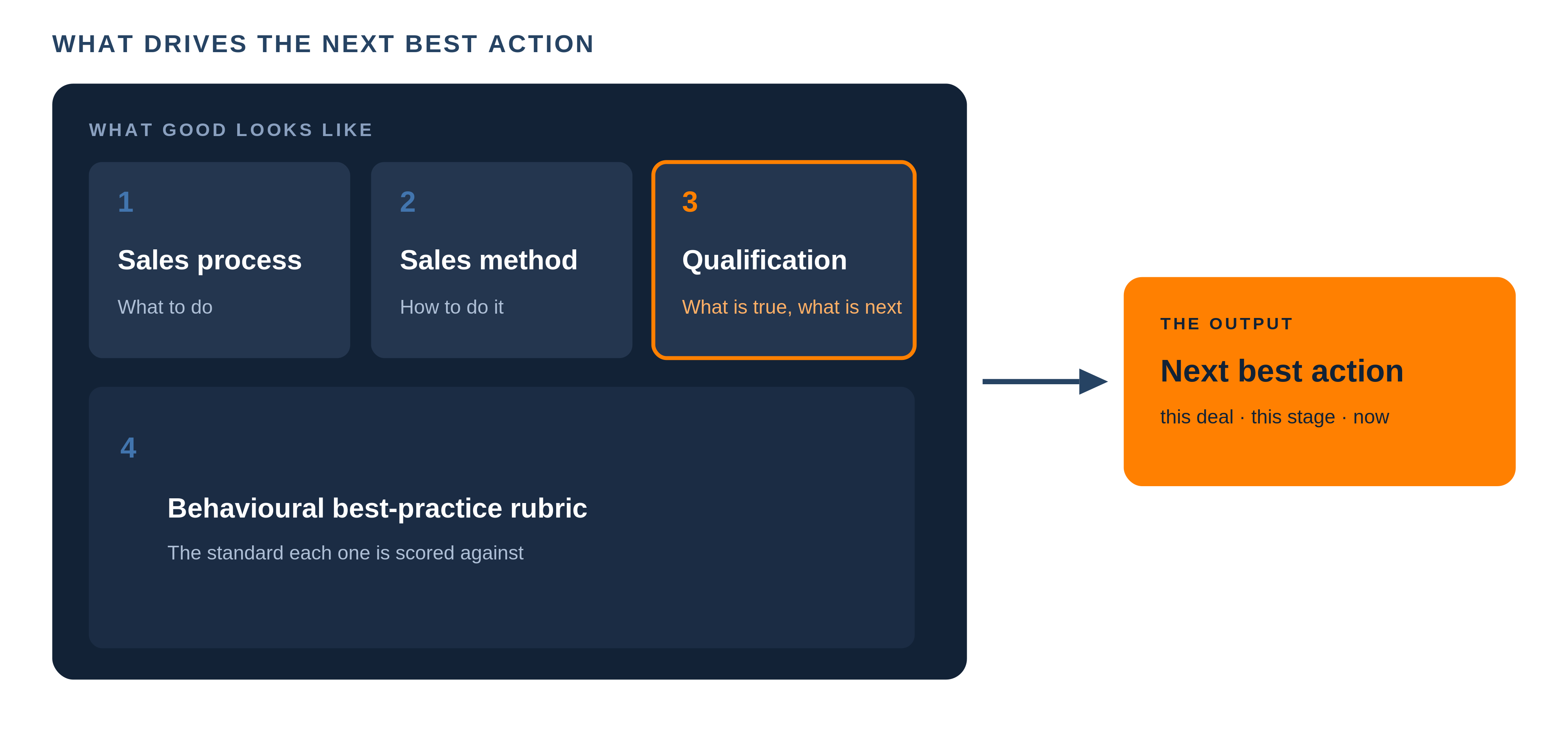
Even a perfectly customised qualification model only answers part of the question. Qualification tells you whether a deal is real and where the gaps are. It does not, on its own, tell a seller what to do next. The next best action comes from three models working together, scored against a shared standard:
- Sales process: what to do, stage by stage, to support how the buyer buys.
- Sales method: how to do it, from running discovery to building the business case and reaching the economic buyer.
- Qualification (the MEDD family): what is true about the deal, and therefore what to fix next.
Score those three against a behavioural best-practice rubric and you get the architecture that decides the next best action for this deal, at this stage, right now, whether a manager gives the steer in a deal review or AI surfaces it in the CRM. Qualification is the layer this article is about, but it only produces good next steps when it sits inside the other two. You can see the full model, and what drives the next best action, on our playbooks page.
How we do it at Closing Foundry
Here is the part the framework debate tends to skip: the letters are not the hard part. In Ebsta and Pavilion's 2023 benchmark of more than three million opportunities, 61% of companies used MEDDPICC, yet only 15% of deals were fully qualified against it. The model with the most letters had been adopted by the majority and used properly by almost no one. The difference was never the acronym. It was the discipline around it.
So we start from your buyers and your sales process, then customise the elements and the meaning of each one to your motion, rather than importing a generic eight-letter template. What "Champion" or "Metrics" requires in a founder-led £40k deal is not what it requires in a seven-figure enterprise pursuit. The standard is then built into the process, the playbook and the weekly coaching, so it shows up in live deals rather than getting logged after the fact. We go deeper on that failure mode in Why MEDDPICC Fails.
We are also deliberate about where AI fits. Plenty of tools will now score a deal against MEDDPICC for you, and that helps, but not at the start. Sellers need the qualification logic embedded in their own heads first, so it shapes the questions they ask in the room, how they read a call afterwards, and what they decide to do next, without reaching for a tool to think for them. Once the thinking is internalised, AI is a multiplier on top of it. Lead with it too early and you get sellers who can run the software but cannot run the deal.
Underneath all of it is one line worth holding onto: MEDDIC, MEDDICC, MEDDPICC and every alternative are scorecards. A scorecard tells you how qualified a deal is; it does not, on its own, change how anyone sells. What changes behaviour is the system the scorecard lives inside, and that is the work Closing OS does: building your chosen, customised qualification standard into the process, the playbook and the weekly rhythm, so it holds in real deals instead of fading after the rollout. We pull that thread in Closing OS vs MEDDPICC.
Further Reading
- MEDDPICC: The Complete Guide, Tools and Coaching
- MEDDPICC, Explained: A Practical Guide for Founders & Sales Leaders
- Why MEDDPICC Fails (and How to Make It Stick)
- Closing OS vs MEDDPICC: A Framework and the System That Runs It
- How to create a sales playbook that works
Related terms
- MEDDIC: The original six-element sales qualification framework.
- MEDDPICC: MEDDIC plus Paper Process and Competition, for complex deals.
- Economic Buyer: The person with budget authority and final sign-off on a purchase.
- Champion: An internal advocate who sells for you when you are not in the room.
- Sales Qualification: Judging whether a deal is real and what is missing before it can close.