

- The model isn't what's getting in the way. AI output quality tracks the quality of the sales system beneath it. A weak system produces confident noise; a codified one produces usable field guidance.
- Four things have to be codified. Sales process, qualification, method and behaviours, written down to a depth the model treats as the standard, not as a suggestion.
- Codification is the real work. It isn't a prompt or a document in a tool. It is structured data the model can handle, running on context, specificity and memory.
- Map AI as connected workflows. Not one autonomous sales agent. A series of bounded steps, each triggered by something that actually happens in a deal.
- The new skill is orchestration. Managers verify and tune what the AI proposes; sellers tell a good next best action from a plausible one. The tool is the easy part.
- Governance is a design choice. AI drafts and recommends, people approve. The CRM stays the system of record. Trust is what decides whether the system gets used at all.
The quality of the AI output is set by the quality of the sales system underneath it, not by the model on top.
We have spent three years putting AI into live B2B sales motions, not talking about it. The models have moved on, from wrestling with GPTs to using Claude skills. The thing that decides whether AI helps or just sounds helpful hasn't changed since day one.
Everyone wants the next best action layer: the system that tells a seller exactly what to do next. That part is close to deliverable today. But it only works if it sits on a defined sales architecture. Without one, the model has nothing real to reason from, so it agrees with whatever it is given, and sounds confident doing it.
Rubbish in, rubbish out. The skill that matters now is codifying how you sell, to a depth a machine can reason with, not buying a better tool.
Why we wrote this
3 years ago, we got a long way with Konica Minolta on a real workflow: inbound lead, through seller preparation, into discovery execution, with the playbook integrated at each step. Three years on, the honest conclusion is that the headline hasn't changed much, although thank god Microsoft Co-Pilot has. It couldn't handle what we gave it back then.
This is a plain account of what we have learned, what good looks like, and the new capability sales managers and sellers now have to build. We're sharing it because the question of how to integrate AI into sales is live for a lot of leadership teams right now, and most of what is written about it is either vague or selling a tool.
The part nobody can skip
The next best action layer only works if it sits on top of a defined sales architecture. Four things make up that architecture, and they have to exist as more than slides.
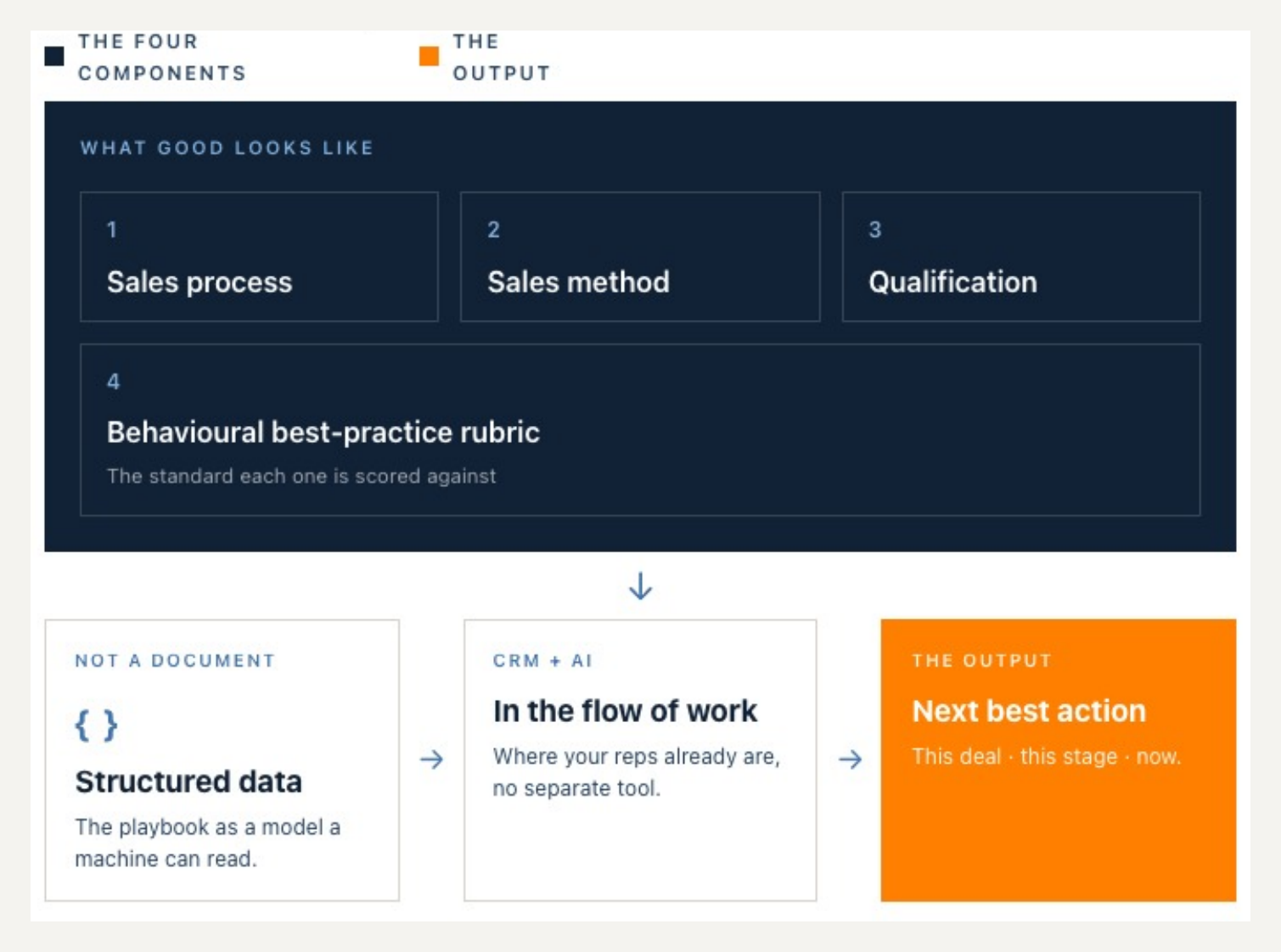
- Sales process and buying process design. Clear stages, defined by observable buyer evidence, not by where a rep dragged the deal. Exit criteria have to mean the same thing to every seller. An AI reading a CRM stage field is only as good as the agreement behind it.
- Sales qualification. A model like MEDDPICC, translated into distinct, consistently captured evidence rather than a framework people can recite. If the economic buyer, business impact and decision criteria aren't captured as structured data, the AI can't tell you what is missing.
- Sales method. What good selling looks like at each stage: the problem, the impact, the root cause, the promise and the payoff, turned into discovery, demo, proposal and business-case guidance. The difference between a feature-led talk track and a problem-led one.
- Codified sales behaviours. The standard each seller is measured against: how to multi-thread, build consensus across a buying group, and position why change, why now and why us. The behaviours that decide deals, written down so they can be inspected.
Codified, those four become structured data a machine can read: the playbook as a model, surfaced in the flow of work where reps already are, producing the next best action for this deal, this stage, now. The architecture decides that next best action, whether it is given by a manager in a deal review or surfaced by AI in the CRM. Same source of truth.
When these four are codified properly, the next best action guidance gets genuinely good: discovery pre-call plans, problem-led demo talk tracks, multi-threading plays, and proposals quantified and positioned using buyer psychology and loss aversion. Without the architecture underneath, none of it holds. The model will tell you it is great work. It doesn't know any better.
The real secret is codification, not the model
The skill that matters is the ability to codify how you sell at the right level, depth and specificity, and then turn that into structured data each model can actually handle. It isn't a prompt. It isn't a document uploaded into a tool. It is the deliberate act of writing down process, qualification, method and behaviour to a depth a machine can reason with.
Three words capture what an AI sales system actually runs on:
- Context. The live deal evidence: account history, call transcripts, what is actually happening in the deal right now.
- Specificity. The codified standard, at the depth that lets the model tell good from plausible rather than agreeable from correct.
- Memory. The system holding all of it together over the life of a deal, so nothing resets between conversations.
Get those right and the model becomes useful. Skip them and you have a confident assistant agreeing with your reps.
From single answers to a workflow
Once the architecture is in place, the logical next step is mapping AI across the sales process as a set of simple, connected workflows. Not one giant autonomous sales agent, a series of bounded steps, each triggered by something that actually happens in a deal.
- Discovery booked. The system produces the pre-call plan: the buyer problem hypothesis, qualification gaps to close, discovery questions, the stakeholder angle and the next-step plan.
- Demo landed. It produces the deck structure and a problem-led talk track, built from the method rather than from a feature list.
- Call completed. It scores the conversation against MEDDPICC and the behaviours the seller should have shown, then drafts the deal review the seller takes to their manager.
- Manager reviews. The manager verifies whether the proposed next best actions are right, and amends as they see fit. The system then produces an adjusted call plan off the back of that judgement.
None of this is exotic. It is deterministic workflow with strong grounding, the model doing the inspection and drafting, people keeping the judgement. That is the design that holds up in a real sales team.
The new skill: orchestrating the work, not just doing it
This is the shift leadership teams need to plan for, and it is a genuine change in the job. The sales manager's role expands: on top of coaching deals, they become the person who verifies and tunes what the AI proposes, decides which judgements stay human, and owns the standard the agents reason from. The seller's role changes too: the skill is no longer just running a good call, but setting up the context, working with the agent's output, and telling a good next best action from a plausible one.
We have started calling the underlying capability agent orchestration: setting up the architecture, managing one agent or several across a sales workflow, and getting the right next best action at the right moment. A seller-prep agent, a manager-inspection agent, a CRM-hygiene agent, each with a narrow job, coordinated rather than collapsed into one monolith.
This is the capability that separates teams who get value from AI from teams who buy a tool and quietly stop using it. The tool is the easy part. The orchestration skill, sitting on a codified standard, is the part that compounds.
Governance is a design choice, not a compliance box
One rule keeps the whole thing trustworthy: AI drafts and recommends, people approve. In every output, keep three things clearly separate:
- What the evidence says: the observed facts from the deal, transcripts and CRM.
- What the system inferred: the reading it formed from that evidence.
- What it recommends: the suggested next action, always visible as a suggestion.
A seller should always see exactly what the AI observed versus what it is suggesting. That separation is what makes the output trusted enough to act on, and trust is what decides whether the system gets used at all. Early on, default to read-heavy access and narrow write authority. Earn write-back once the evidence model and the human review loop are proven.
Why this is the right question now
We are hearing the same thing from investors and boards: they are starting to ask their companies how they are integrating AI into the sales workflow. It is a fair question, and most teams don't have a straight answer yet.
The teams that answer it well aren't the ones who bought the most advanced tool. They are the ones who did the unglamorous work first: codified their playbook into structured data at the right depth, so the AI has a real standard to reason from. That is the gap between a sales motion that gets sharper with AI and one that just gets a confident layer of noise on top of the same inconsistency.
The work is straightforward to describe and demanding to do well. Codify the process, qualification, method and behaviours. Turn them into LLM-ready structured data with the right specificity. Map the workflow. Build the orchestration skill in the manager and the seller. Keep the governance clean. Do that, and the next best action layer everyone wants finally has something solid to stand on.
Further Reading
- AI in B2B Sales: What Works and What Doesn't
- What a B2B Sales Playbook Actually Is (And Why Most Don't Work)
- MEDDPICC, Explained: A Practical Guide for Founders & Sales Leaders
Related terms
- Sales Process: A defined sequence of steps that guides reps from first contact to close.
- Sales Method: A structured framework or approach for running a sales process.
- MEDDPICC: A B2B qualification framework spanning Metrics, Economic Buyer, Decision Criteria, Decision Process, Paper Process, Implicate the Pain, Champion and Competition.
- Economic Buyer: The person with budget authority and final sign-off power in a deal.
- Stage Exit Criteria: The conditions that must be satisfied before a deal advances to the next stage.
- Deal Inspection: A structured review of a deal's health, risks, and next steps.